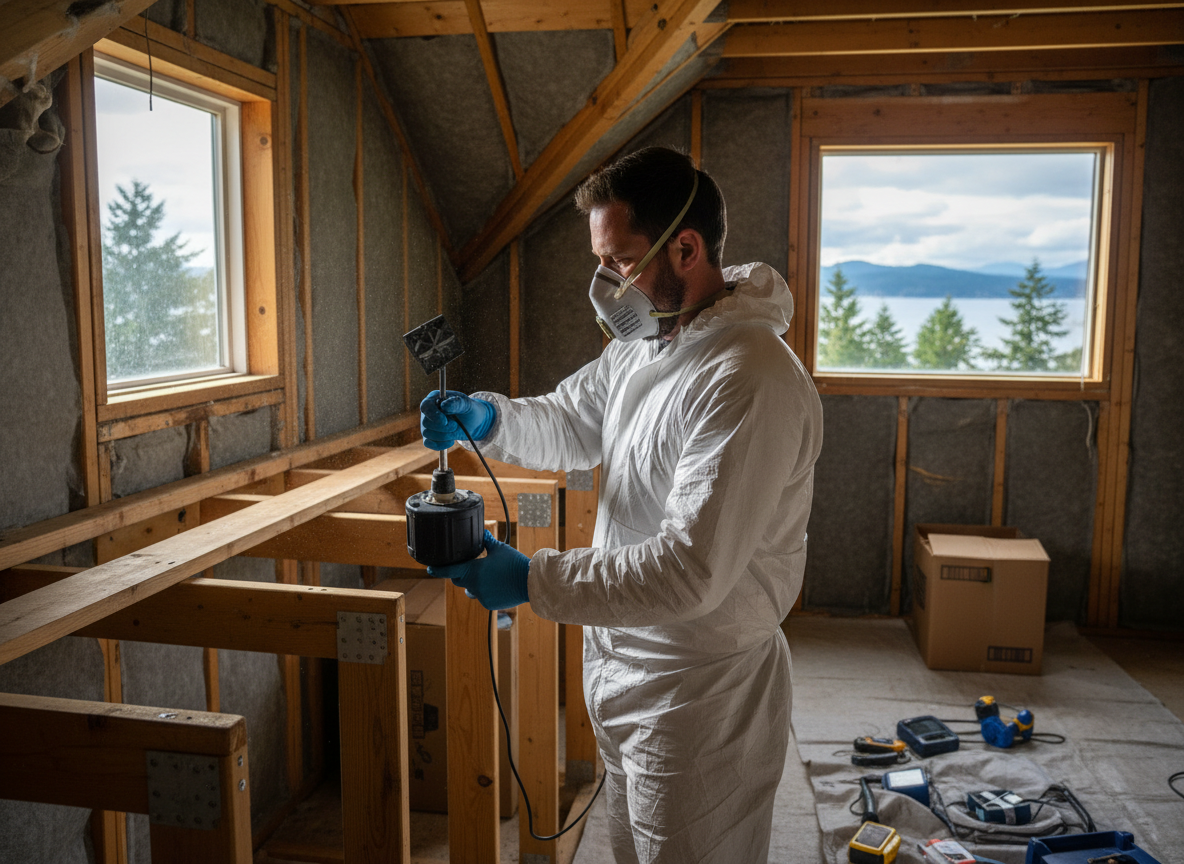
Mold Testing on Camano Island starts with understanding how the mild marine climate and wet winters push moisture into crawl spaces and attics of homes built before modern vapor barriers became standard. In neighborhoods such as Utsalady and Camano City, older single-story houses on sloped lots often trap condensation against cedar siding and particleboard subfloors once temperatures drop. Technicians use moisture meters and infrared cameras to map temperature differentials that signal hidden water behind drywall or under vinyl in bathrooms near Cama Beach State Park.
Air sampling and tape-lift surface samples are collected in living areas, laundry rooms, and garages to compare indoor spore counts against outdoor baselines taken near Camano Island State Park. This data helps distinguish between normal seasonal mold from the surrounding forests and active interior colonies that require source removal. Homes close to Stanwood or Arlington frequently show elevated readings after heavy winter rains because roof valleys and gutter lines on 1970s and 1980s construction allow water to enter wall cavities without visible ceiling stains.
Testing reports note whether the property sits on glacial till soils common across Island County that drain slowly and keep foundation perimeters damp for weeks. Residents receive written findings that list exact sample locations, spore types, and moisture percentages so they can prioritize repairs before the next dry-summer window closes.
Technician insight
In Camano Island, the thing that catches most people out with Mold Testing is assuming that a dry summer means the crawl space under their Madrona Beach house stayed dry all winter. The marine air keeps soil moisture high against older foundations even when the roof looks fine, so we always pull samples from the subfloor framing on the uphill side of the lot.
Hidden Growth Behind Laundry Wall in Utsalady
A homeowner noticed a musty smell after a wet January but saw no stains. Testing revealed elevated aspergillus spores in the laundry room. Moisture mapping found a slow leak at the washing-machine supply line that had soaked the particleboard subfloor and bottom plate for months. We isolated the source, documented the readings, and the owner scheduled targeted removal before the next rain cycle.
How it works
- 1
Initial Walk-Through
Technician inspects every accessible area of the Camano Island home, noting rooflines, plumbing penetrations, and ventilation in attics and crawl spaces.
- 2
Moisture Mapping
Infrared and pin meters locate damp zones in walls, floors, and ceilings without cutting into finishes.
- 3
Sample Collection
Air cassettes and surface lifts are taken from affected rooms plus one outdoor control near the property.
- 4
Lab Analysis and Report
Samples are sent for spore identification; a written summary with photos and moisture readings is delivered within 48 hours.
- 5
Follow-Up Recommendations
Homeowner receives clear next-step options based on findings and the seasonal weather patterns typical of Island County.
Pricing
Cost depends on square footage, number of samples, and whether crawl-space or attic access is required.