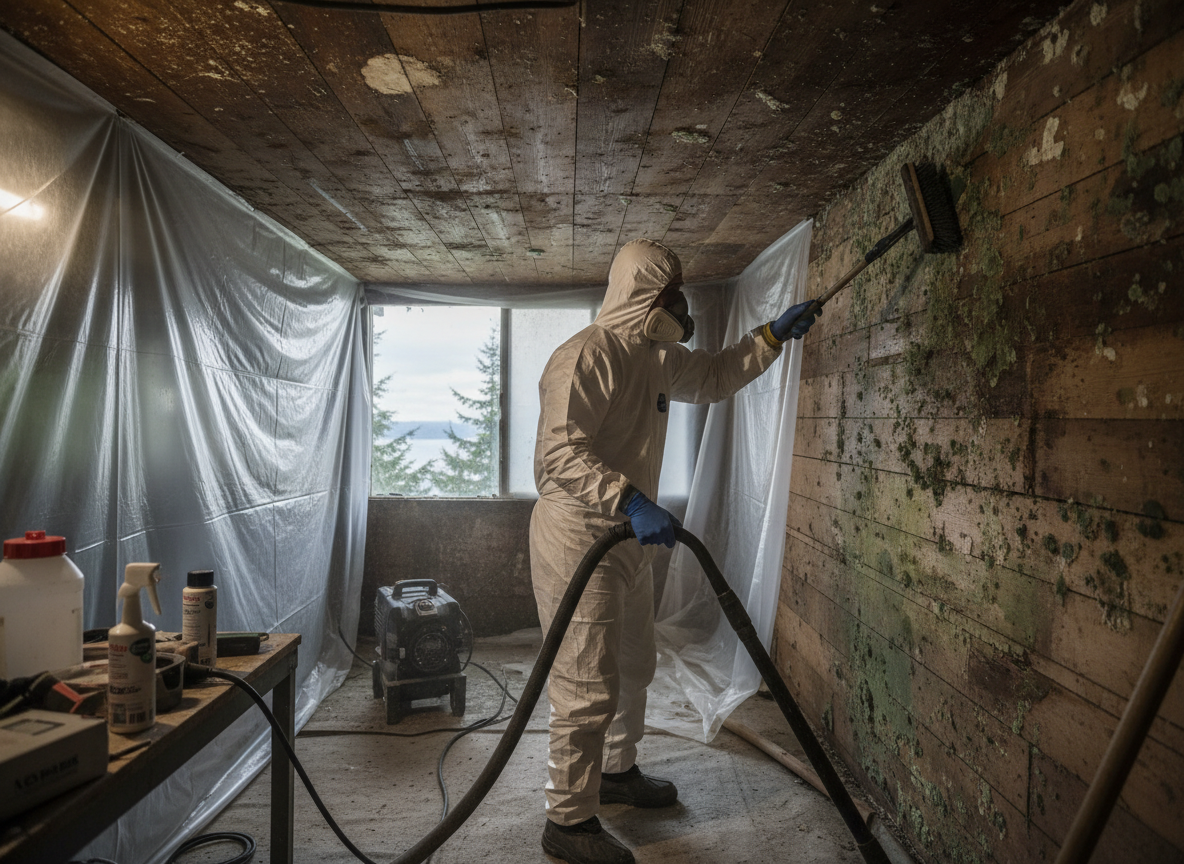
Camano Island homes built before widespread vapor-barrier standards often develop hidden mold colonies in crawl spaces and attic sheathing after repeated winter rains. In neighborhoods such as Utsalady and Camano City, the combination of older cedar siding and limited crawl-space ventilation allows moisture from the mild marine climate to linger well into spring. Technicians must isolate affected zones with negative-air machines and remove porous materials rather than simply spraying surfaces, because mycotoxins remain embedded in drywall and insulation.
Work near Cama Beach State Park and Madrona Beach frequently involves post-storm water intrusion through roof valleys and foundation cracks where clay-rich soil holds moisture against stem walls. Removal crews document every square foot with moisture meters and borescopes before any demolition begins, then bag and label debris for proper disposal at Island County facilities. Air-scrubbing continues for 48 hours after physical removal to reduce airborne spores before final clearance samples are collected.
Because dry summers create a false sense of security, many homeowners in Stanwood and Arlington delay inspection until visible growth appears again the following winter. Proper toxic mold removal requires locating and correcting the moisture source first—usually gutter overflow, plumbing leaks, or poor grading—then verifying that relative humidity stays below 50 percent inside the envelope. Skipping this step guarantees recurrence within one or two wet seasons.
Clearance testing on Camano Island follows the same sampling protocol used in neighboring counties: both air and surface samples are sent to an independent lab, and re-occupancy is not permitted until results fall within acceptable background ranges. Homeowners receive a written report that includes before-and-after photos, material disposal receipts, and a moisture-source correction checklist tailored to the property.
Technician insight
In Camano Island, the thing that catches most people out with toxic mold removal is how quickly wet winters push moisture into the particleboard subfloors of 1970s and 1980s homes in Utsalady and Madrona Beach; once it gets under the vinyl, you have to pull the flooring or the smell never leaves.
Crawl-space growth after winter rains
A Camano City homeowner noticed a musty odor in the living room each January. Inspection revealed standing water and black growth on joists beneath a bathroom leak. We contained the space, removed the affected insulation and subfloor sections, dried the joists, and installed a vapor barrier. Clearance samples passed and the odor did not return the following winter.
How it works
- 1
Initial Assessment
Inspect all accessible areas with moisture meters and borescopes, map visible growth, and identify the water source.
- 2
Containment Setup
Seal affected rooms with plastic sheeting and negative-air machines to prevent spore migration to clean zones.
- 3
Source Removal
Cut out and bag contaminated drywall, insulation, and trim; HEPA-vacuum remaining surfaces.
- 4
Drying and Verification
Run dehumidifiers until wood moisture content drops below 12 percent, then collect clearance samples.
- 5
Final Report
Deliver lab results, photos, and a moisture-correction plan for the homeowner to address.
Pricing
Pricing depends on the square footage affected, the number of hidden cavities, and whether structural materials must be replaced after removal.